Break of Gauge: Why Interoperability Outlives Cleverness
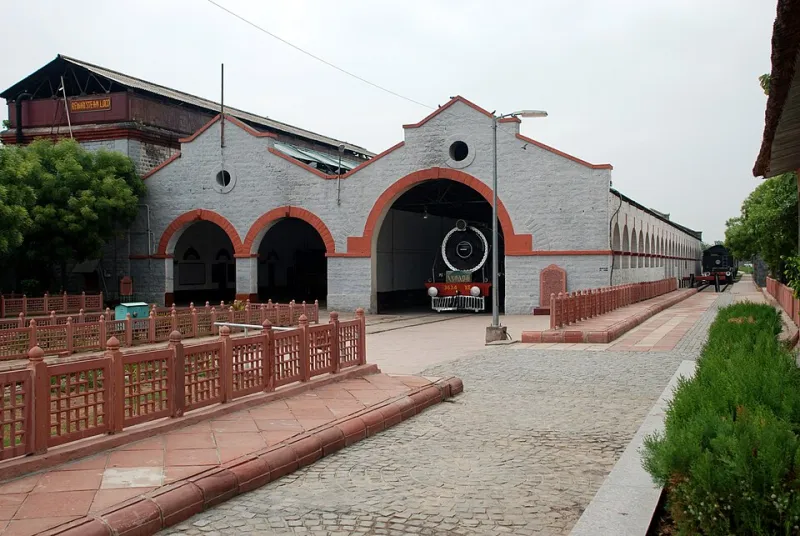
Photo: Sudhirkbhargava, CC BY-SA 3.0, via Wikimedia Commons
Among the more uncomfortable episodes in British engineering history is the spectacle of a demonstrably superior technology losing. Isambard Kingdom Brunel's broad gauge, at seven feet and a quarter inch, produced faster, smoother and more stable running than the four-foot-eight-and-a-half standard that eventually prevailed. It lost anyway. The reasons are instructive for anyone currently choosing a schema, an API style or a data format.
A better railway that went nowhere
The Great Western Railway carried its broad gauge from London to Bristol and into South Wales, and the engineering case was sound: a wider wheelbase permitted larger locomotives, higher speeds and a gentler ride. The rival standard, inherited from colliery tramways and their cart-wheel spacing, was arbitrary — an accident of history rather than a design decision.
Arbitrariness, however, is not the same as weakness. The standard gauge was adopted by more companies, served more towns and connected to more of the country. When the two systems met at Gloucester, passengers changed trains and goods were unloaded and reloaded by hand. The inconvenience was enormous and entirely one-sided: it fell on the party that had chosen the minority system.
Parliament intervened with the Gauge Act of 1846, favouring the standard for new lines, and the broad gauge retreated over the following decades until the final conversion of the Great Western's western lines in 1892. The technically inferior option did not win by argument. It won by weight of numbers.
The arithmetic of networks
Metcalfe's law is often quoted loosely, but the underlying point is blunt: a standard derives its value from the population that speaks it, not from the elegance of its specification. This is why a mediocre API with a thousand consumers outperforms an exquisite one with three, and why the internal framework your platform team finds distasteful will probably outlive the one they prefer.
Engineers habitually evaluate interfaces on internal merit — naming, expressiveness, performance. Networks evaluate them on reach. When the two judgements conflict, reach usually wins, and it wins faster than the proponents of the better option expect.
Sunk costs and the engineer's affection
The broad gauge survived far longer than economics justified, in part because the Great Western had invested heavily in locomotives, rolling stock and depots built to it. Conversion meant scrapping capital that worked perfectly well. It also meant conceding that a decade of confident engineering judgement had been misplaced.
The second cost is the harder one. Technical decisions are personal, and organisations protect them accordingly. A team that has spent three years building an event schema will resist its retirement long after the arguments have turned, because the schema has become a proxy for the team's competence. Naming this dynamic in advance — making it a documented risk rather than an implicit one — is one of the more useful things a technical leader can do.
The break of gauge as an interface boundary
The Gloucester transfer point is a precise physical analogue of an integration boundary. Every handoff between systems adds latency, cost and failure modes; the only question is whether those costs were budgeted. Dual-gauge track, in which one route accommodated both systems, was expensive to lay and slow to run, but it permitted continuity of service — much as an adapter layer permits two incompatible contracts to coexist.
Adapters, however, must be understood as a tax rather than a strategy. They are a legitimate transitional mechanism, and a dangerous permanent one, because they accumulate. An organisation that maintains three translation layers between its internal and external representations has not solved the interoperability problem; it has moved it to a place where fewer people can see it.
Governance is how a network makes a decision
The Gauge Act is frequently criticised as state interference in engineering. It is better read as the mechanism by which a fragmented network resolved a coordination problem it could not resolve privately. Individual railway companies had every incentive to defend their own choice; none had an incentive to bear the cost of convergence alone.
Modern equivalents are familiar: the working group that ratifies an internal API style, the architecture review board that approves a shared data contract, the open standard that a consortium agrees because the alternative is four incompatible dialects. Governance of this kind is unglamorous and frequently resented, and it is the cheapest instrument available for avoiding a break of gauge.
Choosing in 2026
The practical test when selecting a schema, a protocol or a message format is not which option is most elegant but which option the surrounding estate will meet without translation. Ask who else must speak it, what the migration cost is if the answer changes, and whether the choice forecloses a future connection. Brunel's gauge was not wrong about engineering. It was wrong about the country it was being laid across.