From Station X to Silicon Success: Decoding the Innovation DNA of Britain's First Tech Campus

From Station X to Silicon Success: Decoding the Innovation DNA of Britain's First Tech Campus
Long before Silicon Valley's sprawling campuses became the gold standard for tech innovation, a modest Victorian mansion in Buckinghamshire was quietly revolutionising how brilliant minds collaborate. Bletchley Park—codenamed Station X—didn't just crack the Enigma code; it cracked the code for building environments where extraordinary engineering breakthroughs become inevitable.
 Photo: Silicon Valley, via thumbs.dreamstime.com
 Photo: Bletchley Park, via www.cs.virginia.edu
The Architecture of Genius
Bletchley's physical design reveals profound insights about fostering innovation. The estate's layout combined intimate working spaces with communal areas, creating what modern workplace psychologists would recognise as optimal conditions for both deep focus and serendipitous collaboration.
The famous huts weren't randomly scattered across the grounds. Each served specific functions whilst maintaining sight lines to others, enabling teams to work intensively whilst remaining aware of parallel efforts. This spatial intelligence mirrors the most successful modern tech campuses, where engineering teams need both sanctuary for complex problem-solving and proximity for cross-pollination of ideas.
Consider Manchester's NOMA district, where MediaCity UK's broadcasters work alongside fintech startups. The deliberate mixing of disciplines—much like Bletchley's combination of linguists, mathematicians, and engineers—creates unexpected connections that spark innovation.
Talent Orchestration at Scale
Bletchley's recruitment strategy offers perhaps its most valuable lesson for contemporary British tech firms. Rather than seeking uniformly brilliant individuals, Station X assembled complementary cognitive capabilities. Classical scholars worked alongside chess masters, debutantes collaborated with Cambridge mathematicians, and mechanical engineers partnered with cryptographic theorists.
This heterogeneous approach directly contradicts the tech industry's tendency toward homogeneous hiring. Modern British firms building high-performance engineering teams might consider Bletchley's lesson: breakthrough innovation emerges not from assembling identical brilliance, but from orchestrating diverse forms of intelligence.
Cambridge Science Park demonstrates this principle in action. The cluster's success stems from combining pure research institutions with commercial R&D labs, venture capital with academic rigour, and international talent with local expertise. Like Bletchley, it succeeds by making unexpected connections routine.
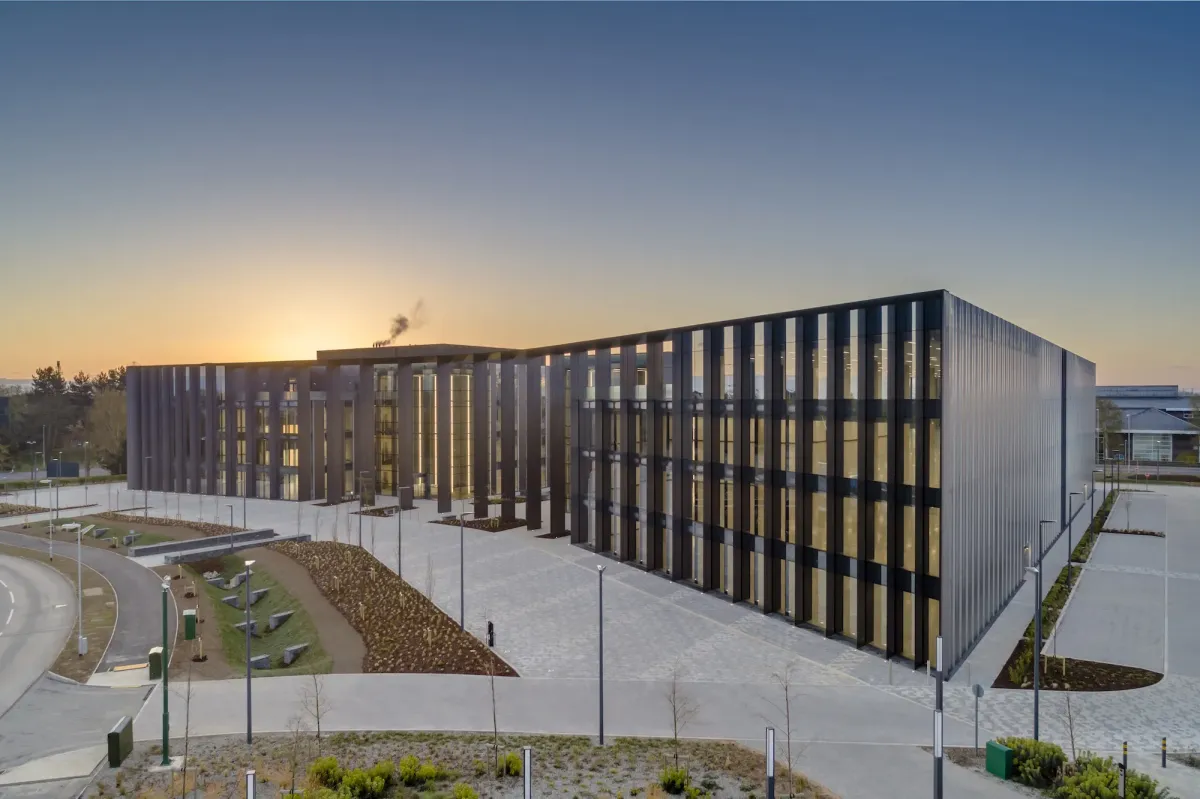 Photo: Cambridge Science Park, via cambridgesciencepark.co.uk
The Culture of Constructive Secrecy
Bletchley operated under absolute secrecy, yet fostered remarkable internal transparency. Teams shared insights freely within their security clearance levels, creating a culture where knowledge flowed efficiently whilst maintaining necessary boundaries. This balance offers crucial guidance for modern firms managing intellectual property whilst encouraging collaboration.
Contemporary tech companies struggle with this same tension. How do you maintain competitive advantage whilst enabling the open knowledge-sharing that drives innovation? Bletchley's model suggests the answer lies not in blanket secrecy or total transparency, but in intelligent information architecture that enables sharing within appropriate boundaries.
Pressure as Performance Catalyst
The wartime urgency at Bletchley created a unique psychological environment where perfectionism gave way to iterative improvement. Teams understood that 'good enough' solutions deployed immediately often outperformed perfect solutions delivered too late. This mindset predates modern agile methodologies by decades.
British engineering firms can learn from this approach to deadline pressure. Rather than viewing tight timelines as creativity constraints, Bletchley demonstrated how urgency can actually enhance innovation by forcing teams to focus on essential features whilst deferring nice-to-have refinements.
Building Modern Station X
What would a contemporary British tech campus designed on Bletchley principles look like? First, it would prioritise cognitive diversity over cultural homogeneity in hiring. Second, it would balance private focus spaces with collaborative zones, ensuring teams can alternate between deep work and knowledge sharing. Third, it would implement intelligent information sharing protocols that encourage transparency within appropriate boundaries.
Most importantly, it would cultivate urgency without panic—creating environments where teams understand their work matters profoundly whilst maintaining the psychological safety necessary for creative risk-taking.
The Bletchley Blueprint for British Innovation
Station X succeeded because it combined Britain's institutional strengths—rigorous academic training, cultural diversity, and understated excellence—with wartime innovation imperatives. Modern British tech firms possess these same cultural advantages but often fail to leverage them systematically.
The lesson isn't to replicate Bletchley's specific methods, but to understand its underlying principles: diverse talent, intelligent architecture, balanced transparency, and purposeful urgency. These elements, properly orchestrated, transform ordinary engineering teams into breakthrough innovation engines.
As British firms compete globally for engineering talent and market position, they might do well to remember that the blueprint for building world-class innovation hubs already exists—tested under the ultimate pressure, proven under the highest stakes, and waiting in the archives of a modest Victorian mansion in Buckinghamshire.