Navigating Digital Waterways: Engineering Lessons from Britain's Canal Revolution
Navigating Digital Waterways: Engineering Lessons from Britain's Canal Revolution
Between 1760 and 1840, Britain underwent a transformation as dramatic as any technological revolution. A network of artificial waterways spread across the nation, creating the world's first truly integrated transport infrastructure. These weren't merely channels carved through countryside—they represented sophisticated engineering solutions to problems that modern software architects grapple with daily: throughput optimisation, bottleneck management, and system standardisation.
The Original Information Superhighway
Before railways, before motorways, before fibre optic cables, Britain's canals served as the nation's primary data transmission network—if we consider cargo as information packets requiring efficient routing from source to destination. The parallels to modern digital infrastructure are striking and instructive.
James Brindley's pioneering work on the Bridgewater Canal demonstrated principles that remain central to distributed systems design. His solution to connecting Manchester's industrial output with Liverpool's port facilities required careful consideration of capacity planning, route optimisation, and performance bottlenecks—challenges familiar to any architect designing microservices infrastructure.
Locks as Rate Limiters: Managing Flow Control
The canal lock represents one of engineering's most elegant solutions to a fundamental problem: how do you maintain system integrity whilst allowing controlled passage between different operational levels? Modern software architects face identical challenges when designing API gateways and implementing rate limiting.
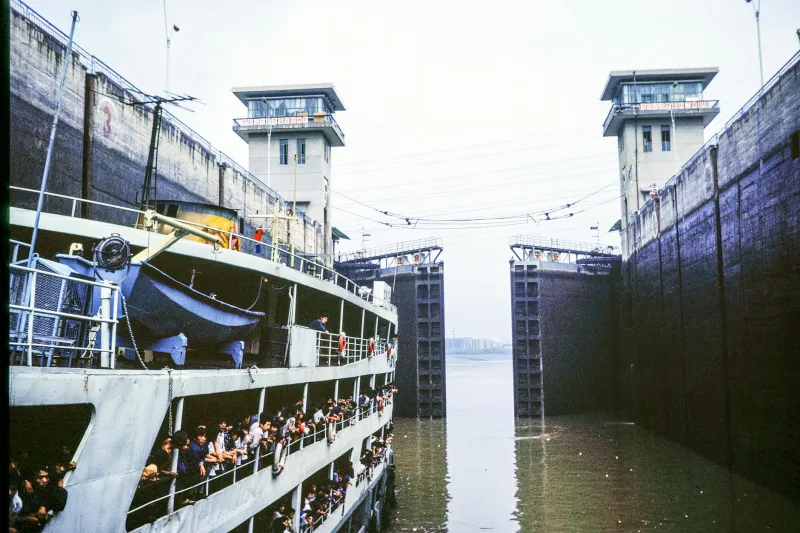
Consider the mechanics of a canal lock. Boats enter the chamber, gates seal the system, water levels adjust gradually to match the destination level, then gates open to allow passage. This process serves multiple functions: it prevents system overload, maintains operational integrity, and ensures orderly processing of requests—precisely what a well-designed API gateway accomplishes in distributed systems.
The capacity constraints of locks also forced canal engineers to optimise for batch processing. Rather than handling individual boats, locks processed groups efficiently, minimising the overhead of level changes. Contemporary message queuing systems employ identical logic, batching requests to optimise throughput whilst managing resource consumption.
Standardisation: The Foundation of Scale
Britain's early canal boom suffered from a critical flaw: lack of standardisation. The Leeds and Liverpool Canal used boats 62 feet long and 14 feet wide, whilst the Grand Junction Canal accommodated narrowboats of different dimensions. This incompatibility created friction at interchange points and limited network effects.
The lesson resonates powerfully with modern software development. Microservices architectures succeed when services communicate through standardised interfaces—REST APIs, message schemas, data formats. Proprietary protocols and bespoke communication methods create the same bottlenecks that plagued early canal networks.
The eventual standardisation around narrowboat dimensions (72 feet by 7 feet) enabled true network effects. Boats could traverse the entire system without transshipment delays. Similarly, containerisation technologies like Docker succeed because they provide standardised runtime environments that eliminate "works on my machine" problems.
Aqueducts and Abstraction Layers
Thomas Telford's magnificent aqueducts—particularly the Pontcysyllte Aqueduct in Wales—demonstrate sophisticated thinking about abstraction layers. Rather than forcing the canal to follow natural topography, Telford created artificial bridges that allowed waterways to cross valleys and rivers at optimal levels.
This approach mirrors how modern software architects use abstraction layers to decouple systems from underlying infrastructure complexity. Database abstraction layers allow applications to operate independently of specific storage implementations, just as aqueducts allowed canals to operate independently of natural terrain.
The engineering principles remain consistent: identify the optimal logical path for your system, then build infrastructure to support that path rather than compromising system design to accommodate environmental constraints.
Reservoirs and Caching Strategies
Canal engineers quickly discovered that water management was as crucial as route planning. Locks consume water with each operation—water that must be continuously replenished from reservoirs positioned at strategic points throughout the network.
This water management system provides an excellent analogy for caching strategies in distributed systems. Reservoirs store resources close to points of consumption, reducing latency and system load. Similarly, content delivery networks and application caches store frequently accessed data near end users, minimising response times and reducing load on origin servers.
The positioning of canal reservoirs required careful analysis of usage patterns and flow dynamics—precisely the considerations that inform cache placement in modern distributed architectures.
Maintenance Windows and Planned Downtime
Canal systems required regular maintenance—dredging, lock repairs, structural inspections. Engineers developed sophisticated scheduling to minimise disruption to commercial traffic, often coordinating maintenance across multiple canal companies to optimise network availability.
Modern DevOps practices employ identical principles. Planned maintenance windows, blue-green deployments, and rolling updates all derive from the fundamental insight that complex systems require regular maintenance that must be carefully coordinated to minimise service disruption.
Lessons for Contemporary Architecture
The engineering principles that made Britain's canal network successful translate directly to modern software infrastructure:
Flow Optimisation: Design systems to handle expected throughput with appropriate buffering for peak loads, just as canal engineers sized locks and channels for projected traffic volumes.
Bottleneck Identification: Monitor system performance to identify constraints that limit overall throughput, analogous to how canal engineers identified and addressed capacity limitations at critical junctions.
Standardisation Benefits: Embrace industry standards for protocols and interfaces to maximise interoperability and network effects, learning from the costly incompatibilities that plagued early canal development.
Strategic Resource Placement: Position computational resources and data caches based on usage patterns and latency requirements, following the logic that guided reservoir placement in canal systems.
The Enduring Legacy
Britain's canal engineers solved complex systems problems with elegance and efficiency that modern software architects would recognise and admire. Their solutions emerged from practical necessity rather than theoretical frameworks, yet they embodied principles that remain fundamental to distributed systems design.
As we design increasingly complex digital infrastructure, we might profitably study these 18th-century engineering solutions. The waterways that transformed Britain's economy offer timeless lessons about managing flow, optimising throughput, and building resilient, scalable systems.
The canals may have yielded primacy to railways and motorways, but their engineering principles flow onward through the digital waterways we construct today.